


Program: Critical Thinking for STEM
Think Deeper. Question Smarter. Discover More.
The biggest breakthroughs in science, technology, engineering, and mathematics begin with more than knowing the right formula. They begin by asking the right questions.
 What do we know? How do we know it? What evidence can we trust? What assumptions are we making?
Critical Thinking for STEM challenges curious students to go beyond doing science and math to thinking deeply about how we understand the world.
Join us for an exciting, highly interactive week of investigation, discussion, and problem-solving.
Put your thinking to the test…
- Evaluate evidence and distinguish strong conclusions from weak ones.
- Challenge assumptions—including your own.
- Ask better questions and construct logical arguments.
- Approach complex problems from multiple perspectives.
- Consider the ethical questions that accompany discovery and innovation.
Build the rigorous thinking skills that prepare students not simply to participate in STEM, but to become its future thinkers, innovators, and leaders.
For Students Entering Grades:
On the Campuses of:
- Stanford University
Ready To Enroll?
Let's Get Started!Go Beyond the Formula.
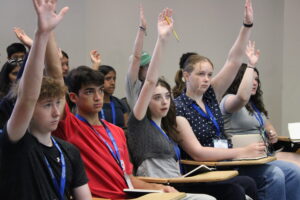 STEM classes teach students powerful tools: equations, scientific principles, mathematical models, laboratory methods, and technical skills. But knowing which tool to use is only the beginning.
What separates following a scientific process from truly thinking like a scientist?
The most consequential work in STEM requires something more: the ability to determine whether you are asking the right question in the first place.
In Critical Thinking for STEM, students explore how great scientists, mathematicians, engineers, physicians, and innovators reason through uncertainty. They investigate how evidence becomes knowledge, how assumptions shape conclusions, how models help—and sometimes mislead—and how new discoveries can overturn ideas that once seemed certain.
Students read great thinkers in science like Galileo, Charles Darwin, Thomas Edison, Francis Bacon, Jane Goodall, Carl Sagan, Rachel Carson, Stephen Hawking, and more. Discussions build the intellectual habits behind rigorous scientific thinking: questioning, analyzing, revising, debating, and remaining open to evidence that may change their minds.
The goal is not simply to solve the problem in front of you but to understand it.
The Skills Behind Scientific Breakthroughs
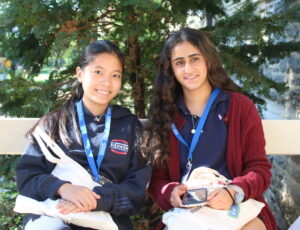 Throughout the week, students strengthen their ability to:
- Evaluate evidence — How strong is the evidence behind a claim?
- Challenge assumptions — What are we taking for granted?
- Ask better questions — What question might lead us somewhere entirely new?
- Identify bias — How can expectations influence what we notice, measure, or conclude?
- Test explanations — What alternative explanations might fit the same evidence?
- Reason logically — Does the conclusion actually follow from the information available?
- Think probabilistically — What can we reasonably conclude when certainty is impossible?
- Recognize limitations — What doesn't our experiment, model, or data tell us?
- Revise conclusions — What happens when new evidence contradicts what we thought we knew?
- Communicate reasoning — Can we explain not only what we think, but why?
These are skills that reach across biology, medicine, engineering, physics, mathematics, computer science, and emerging technologies—and become increasingly important as the problems become more complex.

From Problem Solver to STEM Leader
The next generation of STEM leaders will need more than technical expertise.
They will face questions whose answers aren't in the back of a textbook. They will work with incomplete information, rapidly changing technologies, competing explanations, unexpected results, and decisions with real consequences.
They will need the confidence to question an assumption everyone else has accepted. The discipline to separate evidence from intuition. The imagination to see another possibility. The humility to revise a conclusion. And the ethical judgment to ask not only what is possible, but what should be pursued—and to consider the human consequences of what they create and discover.
Critical Thinking for STEM gives students a place to practice those habits now.
Because the students who will make the next great breakthroughs won't simply know how to use the formulas.
They'll understand how—and when—to question what everyone thinks they know.
Join Us!
A great addition to Great Books and Big Ideas or Entrepreneurship or a wonderful standalone program, Critical Thinking for STEM teaches students how to become more rigorous STEM thinkers.
On The Campuses Of:
Stanford University
For Students Entering Grades:
9-12 (High School)One & multi-week programs available:
- July 4, 2027
